Showing posts with label humane. Show all posts

Sunday, February 23, 2014

Lessons Learned from the Hen House, Way to Care for Chickens

Moltie, the goofy runt White Leghorn with Comet & Zucc.
Fostering six 3-yr old chickens has nearly come to an end. In July the family that raised this flock of White Leghorns and Brown Comets will be returning to Virginia from a military stint in Hawaii.

We had never had chickens so initially we were a little afraid of them. Scampering around adorned with sharp pointy toes, floppy red combs, and flappy wings. Attempting to take flight when anyone approaches or while the owner is proudly showing them off. Pecking at your calf, shoe, or heaven forbid eyeglasses! Unknowingly I had a tick on my calf and my chicken made me aware of it, two strikes and it was quickly removed.

We hauled in a kids playhouse from freecycle.
Each chicken has a different personality. We had the runt, the vocal one, the one that was constantly victimized, the curious one, the scaredy-cat, and the pecker (that would be the tick grabber). Small backyard chicken owners get to know their individual chickens and become attached to them, like any pet. You want to protect them, love them, care for them, and play with them. Some people even bring them inside to live, buying chicken diapers for them.

Don't be alarmed when they Molt - drop feathers - it's natural.
We went to great lengths to provide a safe and healthy home for our feathered friends. Designing and building an elevated coop that has proven to - so far - be predator proof and a dry place for the chickens to hang out on rainy days (Chickens want to be outside regardless of the weather but do not like to be rained or snowed on). We installed two windows so the coop would naturally heat up in the winter (one that opens to cool it off in the hot summer).

Our coop nearly buried in snow - keep a path shoveled.
I've lost many nights of sleep worrying about our little flock locked up in the coop all night... will a fox get to them, will they freeze to death, or will they turn on their own and kill the runt! Chickens can be very cruel, going after the most timid. We spent one whole year devising fencing and rotation to keep one chicken away from the flock otherwise we would find her battered and bloody. Finally after a few of the meanies died off, we could put her back with her flock. We always let her go up to roost in the coop at night LAST. Hell or high water, chickens will NOT come off their roost at night so she was safe to roost but we had to open the coop at the first crack of morning light or she would have been massacred. It's amazing that after the natural deaths of 4 of our 6 chickens, she still remains!

You should see grains in the feed!
I sold eggs when I had 4 - 6 hens finding two loyal customers on craigslist. We would feed a locally ground non-GMO feed. Feed is very different depending on where you buy it. We started with the standard feed store variety and moved up to a better grade of feed. We didn't spring for the soy free organic as it was so expensive. Do not buy your girls low grade crap. Seek out a nice grain that LOOKS like grain! I was shocked to see the difference. One looked like gravel compared to my feed - never buying it again. They say girls quit or slow down laying by 30% each year but I did not find this to be true until the later years. My Comets laid a huge egg EVERY DAY for 5 years! My leghorns slowed down a little with each passing year after age 4 but I have 2 leghorns living now and all my Comets have passed on so all that egg laying really does wear them out. If you are going to raise chickens for selling eggs - good luck - I never made a profit because feed is so expensive (any feed).

We adapt to predators, our Coopers Hawk.
Chickens have a reputation of being garbage disposals, being able to consume anything. After trying many foods, I've learned that carbs can nearly kill them! They love spaghetti and one day I cooked them a big pot - they gobbled it all up and for 3 days they hardly moved and their crops were blown up and clogged. I massaged their crops 3 times a day for 3 days and gave them teeny pieces of bread soaked in olive oil to try and get some grease in there. I think they would have died if I would not have helped. LESS is BEST. I do like to give them a little treat every other day. Very small portions - often in small bits of ONE thing. They love corn cobs (one for 2 chickens), blueberries, strawberries, Zucchini, and watered down oatmeal (1/4 c for 4 chickens). Anything that expands (bread, pasta) can clog their crop so I stopped giving both - do not kill them with kindness! DO NOT GIVE AVOCADO or APPLES (seeds toxic)! My chickens refuse to eat purple lettuce!  Only green for them! They also LOVE STINKBUGS! Google before you give them anything to ensure not toxic! Each chicken will like different things - they are often picky!

In the coop - nice and clean!
I learned early on that keeping grass alive in the immediate Chicken Coop area was near impossible. I do rotate the chickens into one area while I reseed the other - swapping back and forth so it doesn't all turn into solid mud.  I'm not raising pigs here! Chickens will also mess up a food or water bowl in a minute if you don't elevate them.  They only have legs to scratch with and this is what they do all day long - peck and scratch - in the dirt and on the food tray. We've devised some inexpensive ways to elevate both. I use plastic plant trays to take care of the water bowl and bent rebar into a hook to hang the food.

Wire, fencing, and CDs to deter Hawks!
I visited a coop located in downtown Cville to get some free supplies and felt so sorry for the hens. The family was afraid to let them out to roam because one day they saw a hawk.  YES, I too freak when I see a hawk but you can provide a little scratching area without keeping them locked up in a wooden box 24 X 7. I've hung wire, plastic fencing, and shiny CD's from my coop over to the fence to hopefully frighten off hawks. I would rather my chickens live a life doing what they love most than to be no better than factory farm raised. But heed the warning - you MUST first and foremost protect your flock. We all want our flock to merrily free range to their hearts delight BUT there are many, many predators and I've heard the sad stories over and over... but I just forgot one time... You can not let your guard down for a single day. Do not forget to lock them up at dusk in their coop, possum and foxes are cunning and smart. Raccoons have been known to pick locks. We have 2 doors that open differently so if they get in one, hopefully they will give up! We have four partitioned fenced areas: 1) under coop area 2) immediate right side coop area 3) left side coop area for emergency separation 4) expansion free range area.  When in the (4) expansion area, I have to be outside or keep one eye outside to make sure they don't fly over or get nabbed by a predator (beware of possible visiting dogs - the biggest killer of chickens). If you plan to totally free range without fencing, plan on tears - it's just a matter of time before your flock gets attacked.

Keep your coop clean - we laid linoleum in the bottom of our coop and it has worked great for 3 years! I completely clean it out and wipe it down - windows and all in Spring and Fall - periodically removing waste each month. We also built an elevated wire grate that sits over droppings from roosting at night so the girls don't walk or stand in their droppings.   I get donated sawdust (as long as not treated or cedar) that I sprinkle over the grate and droppings each am. I have a water bowl in the coop and outside that gets changed EVERY am when I feed them. Do not over feed! You will only attract RATS! Keep all feed tightly contained in metal - animals will eat through the toughest plastic.

Chickens are work but provide so much joy. It's even fun getting the system down! The returning family that raised my flock has expressed interest in raising a new flock, may be they will let the two old gals live out their days here with us... we'll see.

-Rebecca

Friday, August 3, 2012

Life Pledge #3

My Gus and Cesar fresh from the Animal Shelter.
Actually, this should have been my Pledge #1 because it has been my commitment for the past 15 years and I feel very strongly about it.

I Pledge to never purchase a pet through a Pet Shop, Breeder, or Online Seller.  I exclusively will adopt from a reputable Animal Shelter, Rescue, or by "discovery".  For the sake of not making this post too long, I am going to talk specifically about dogs but I feel even more strongly about cats. 

Wonderful hound, a typical breed found in local shelters.
Thankfully over the last decade, Animal Welfare groups have taken on the cause of shutting down inhumane Puppy Mills.  The battle is ongoing as is the battle for safe food, fair taxes, and the like.  There always seems to be someone making a buck that is fighting tooth and nail to continue their vice at any cost.  This is the case with Puppy Mill owners.  They will do anything to keep their cruel moneymaker bringing in the cash.

I have seen first hand the misery caused by Puppy Mills.  While the Director of a Humane Society located inside of a county owned kill Animal Shelter, there were many instances of abuse as a direct result of Puppy Mills and irresponsible Breeders.  Personally, until there are no more pets killed in U.S. shelters, I choose to not adopt from responsible Breeders as well.  It's simple economics... Why would I trade the life of a shelter pet for one purchased from a breeder?  I wouldn't. 

A "vicious" shelter Pitbull & PCHS Pres. Rita.
Let's get to the numbers.  You may think only small numbers of pets never make it out alive of Animal Shelter Agencies.  Think again.  In 2011 in the State of Virginia, almost 80,000 dogs and cats never found their new home.  Nationwide in the U.S. up to 4 million are euthanized each year.  The numbers are staggering and to think they have actually improved over the last decade due to the hard work by Humane Societies, SPCA's and dog Rescues Groups.

A growing trend is to hide the cruelity by selling pets on the internet masked by cute or heart wrenching websites.  You may think that "others" are doing their part and picking up the slack for your decision to adopt from an unknown online dealer -- NOT...  According to Wayne Pacelle, CEO and President of the HSUS, only 1 in 5 owned pets are adopted from a Shelter or Rescue.  More people need to face the facts and the numbers that animals are dying directly because of their purchase decisions. 

My sweet doggie Simba, my first shelter pet.
Being part of the humane movement for years gave me that first hand look into what is good and bad.  I can attest that Puppy Mills and breeders, breeding purely out of greed, diverted charity group resources toward animal rescue instead of animal prevention services.  Funds are always limited and can easily dissolve when animals are so mistreated that they require medical care at the charities expense.  Compound this problem with the arrival of 50+ abused and neglected Puppy Mill dogs and you are looking at a huge expense and housing problem.  Many agencies are already maxed out on both fronts.

While I was in the midst of pet madness as Humane Society Director, I often wanted to scream at the top of my lungs (and actually did) for people to take this issue seriously and NOT PURCHASE A PET but ADOPT instead!  Irresponsible breeding takes such a physical and mental toil on the good souls that are trying so desperately to help our little furry babies.  Kindness and love has totally disappeared from the souls of Puppy Mill breeders... it's time they were put to a stop and you can help by making thoughtful and humane purchase decisions. 

-Rebecca

Wednesday, December 22, 2010

Chicken Sitting

My neighbors went on a family ski trip and fortunately I was asked to check on their chickens while they were away.  These are "pet" chickens, living with a family of three young primary caretakers.  They built a nice safe coop for the chickens.  They roam the yard and are often picked up and loved.  These are really healthy, "spoiled" chickens that are layers, they are not for "dinner". 

They have a flock of six chickens, three white and three brown feathered... which means you get a combo of brown and white eggs.  During this time of year you get one egg per chicken, laying all their eggs typically before noon.

The first day Anthony and our doggie Simba joined me to check in on the chickens.  I never knew chickens were so eager to EAT.  My neighbors eldest child gives them cooked oatmeal each morning.  I decided to bring down a bowl for them.  It was devoured in about ten seconds!  Thank goodness I was thinking "possible dog fight behavior" and brought separate bowls.  The chickens REALLY like oatmeal.  There was a lot of commotion, cackling, beak slapping on the container, and wing puffing.  The next day Simba and I brought down triple the amount and bigger bowls.  They really enjoyed their reward for laying six lovely eggs. 
You can't force a chicken to lay - we only got five eggs 1 day.
When you buy "standard - cheap" eggs at the grocery, chickens are raised in a way that is NOT comparable to the Norman Rockwell farm imagery of our youth.  Every time I would drive down to Georgia, crossing the state of South Carolina, I would run into a chicken truck.  That for me was enough to make me at a minimum seek out cage free eggs.  That's at least a step in the right direction.  If you can find a local farmer offering free range chicken eggs and you can SEE the treatment, that of course if the best source for cruelty free eggs.

You as a consumer CAN make a difference.  Chickens are COOL.  I'm so glad my neighbor SHARES their bounty with us.  It's WONDERFUL. 

-Rebecca

Wednesday, December 1, 2010

Help Feral Cats

I'm feeling no pain waking up from surgery
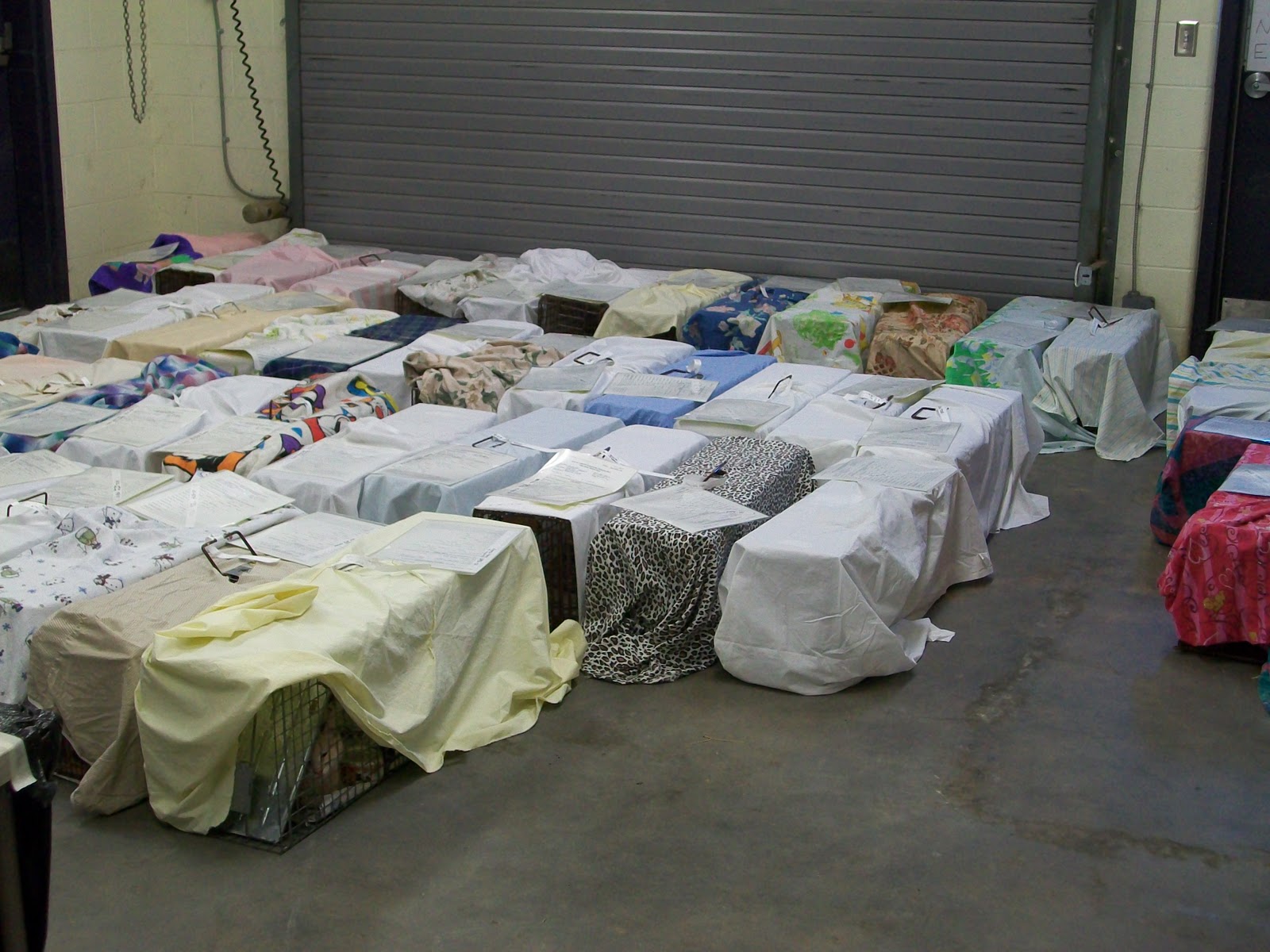
One Saturday a month during the cool seasons of the year, Voices for Animals coordinates the Feral Cat Clinic held at the Charlottesville Albemarle SPCA to spay and neuter approximately 100 cats in 8 hours.  Ferals are cats that can not be handled by humans and require trapping in order to be safely caught.

--- A female cat continuously cycles in and out of heat and can get pregnant while nursing a litter so spaying is the humane way to control feral cat populations.  Otherwise you can guarantee continual births of babies in the wild time after time after time. ---

Your ears are fifie dirty!
This is my second year of volunteering for the Feral Cat program.  The clinics have been run for so many years that it is a very structured and organized effort.  Some volunteers have participated season after season and are pros.  Most volunteers work "hands on" at various surgery "stations" such as prep, pre-surgery, fluids, medications, and recovery. 

Other volunteers provide support by trapping and returning the cats back to where they originated or bringing in food for the volunteers.  Mass quantities of delicious vegan dishes magically appear each morning and continue through lunch.  Seventy volunteers have to be fed throughout the 8 hour (+/-) surgery day.  Approximately five vets perform the surgeries along with licensed techs and other trained staff.

The program addresses a community need by controlling cat populations in order to help these animals which may otherwise never receive vet care.  If an injury is discovered the cat is treated or patched up.  All cats are vaccinated for rabies and distemper and are humanely sterilized, undergoing the same surgery protocol found in any veterinarian hospital.

Just a few trapped cats - cages are covered to reduce stress
You may be asking, why not just permanently remove the cats?  This has been studied and once you remove the cats, more cats come into the community and set up camp, restarting the cycle once again.  Working in a shelter, I can promise you that euthanizing feral cats does nothing to control the population.  The same people would bring in cats year after year, never relieving themselves of cats!  The proven solution is to stay on top of the situation and get them fixed and release them back where you found them.

If you know of a cat that is roaming in the Charlottesville area and may need to be fixed OR if you can help volunteer, please contact Voices for Animals.  They are eager to help guide you through the process and help a feral in need!  

-Rebecca

For Southwest Virginia Readers, Spay Clinics in your area:  Pulaski County, Montgomery County
Related Posts Plugin for WordPress, Blogger...