Showing posts with label farm. Show all posts

Thursday, November 17, 2022

Fall is a great time to buy a Lemon Tree

Fall is it the prime time that Lemon Trees produce fruit for the picking, at least in Virginia!  A friend told me about a local farm that sells Lemon Trees! Bill has propagated 100's of Meyer Lemon shrubs. Conveniently located near the Ivy Landfill (we go there every few months to dispose of household trash and recyclables) I picked up a gallon sized shrub. 

My shrub in my heated Greenhouse all cozy
Bill helped us select the perfect specimen having 7 lemons developing along with fragrant blooms. I did not realize that it takes 9 months from bloom to fruit harvest. Wowza. So right now is a great time to snag a lemon tree and enjoy some fruit over the Winter months. 

They can be successfully enjoyed indoors in your brightest sunny window. To aid in pollination, you can take a paintbrush and lightly transfer pollen from bloom to bloom to encourage a robust crop. It's best to move them outdoors in the Spring once all signs of frost have abated. 

Quarters Farm also sells fresh eggs and has a 175 year old home for daily rent that would be a great remote Winter hideaway.

The greenhouse does not have standard hours but Bill is very flexible as to when you can snag a Lemon tree or pick up some eggs. Just send him an email (listed on their website) to set up a time when you are over that way.

~ Rebecca  


Saturday, May 23, 2015

The new Chickens have Arrived - Name that Chicken


New chicks!
Several days ago we received a wonderful gift of 6, 6 week old chickens hand raised by my neighbors. If you have been reading my blog for awhile, you might remember that we fostered 6 chickens for our neighbors when they temporarily relocated to Hawaii for 3 years. We loved our little flock and as the time passed we lost 4 from natural causes.

Moltie from my prior flock, always on the go & into something

When my neighbors returned, we gave them back their 2 remaining White Leghorns. My favorite chicken, Little Moltie, was one of the survivors. When we acquired the chickens they were 3 years old. Now, they are nearly 7. It's amazing to think they have lived this long. Apparently they have decided to kick back in gear and actually lay an egg nearly every day! It's very rare for a chicken to continue laying at this age. They are very happy and free range among lots of trees and leaves. I believe all the nutrients they scavange from nature has helped bring this along.

This is a no kill zone people - says Big Red
On industrial farms chickens are culled at 18 months when they first molt and egg production temporarily stops. It's cheaper to buy another set of pullets (young chickens) than to wait for them to begin laying again. Chickens can lay for many many years if free ranged and allowed to live a life naturally, as intended.

Chicks finally roosting, sleeping soundly.
So what's new on Forsythia Hill... Janie (Dominique), Iris (Welsummer), Cleopatra (Red Dorking), Big Red (Rhode Island Red), Raven (Australorp), plus one unnamed (Buckeye). I really wanted a mix of breeds to see how they differ in laying and in personality. Janie is the leader of the pack, Big Red is the sweetie, Raven is the smartest, Cleopatra is the prettiest, and little Iris is the baby. She is often heard crying if anyone is strays from the flock she SHRIEKS... come back, don't stray, you might not find your way!

Janie, don't mess with me chickens or else!
A small flock requires a secure space for roosting at night and ranging during the day. There are many predators; foxes, hawks, raccoons, opossum, & dogs (to name a few). Chickens are just plain fun but like any pet be prepared for some work and expense to feed and care for them. If you are outside often and can provide an entertaining space for them and socialization you will get the most from your flock (more about how to keep your chickens busy throughout the day in a future blog post).

I need a name please
Name my chicken! One last chicken needs a NAME. She is unusual in that she has 5 toes. Most chicken breeds have 4. She is identical in coloring to Cleopatra but they are different breeds. Please post your suggestion on my blog.

-Rebecca 


Sunday, June 22, 2014

Downtown Cultivate Charlottesville Garden Tour

Casa Alma veggie garden, one of many
Yesterday the Cultivate Cville Urban Farm and Garden Tour was held to bring awareness to the many community gardens operating in downtown Charlottesville, Virginia. The five gardens on the tour ranged from children's educational gardens to open citizen volunteer gardens. There is a true back to the earth movement in Cville and I was happy to see it in full swing. All gardens operate on organic principles with sharing and caring a top priority.

Wall mural a vibrant backdrop to the Buford School garden
I was impressed with the Buford Elementary School garden and the commitment by the Principal and staff to incorporate school curriculum with hands on garden experiments. This garden develops more and more with each passing year.

rustic garden shed Buford Elementary garden
Physical Education classes provide the option for students to work in the garden. Being that I have now gardened for over 25 years, I can attest to the physical requirements necessary to work a garden. Science classes conduct growth experiments with plants growing inside their new hoop house verses outside. It's a darling garden with flowers, herbs, and vegetables.  A handmade shed, sitting ring of logs, and cute garden features make this a joyful garden. All six of the Charlottesville City Schools are now involved with the City Schoolyard Garden program.

Flags representing each garden bed in the 5th Street garden
We headed over to the 5th Street Community garden which was just started this year. It is mainly an immigrant garden with each, of the many, planting beds representing an individual country. Speaking with one of the proud gardeners, it made me think of my move from my family home to Charlottesville and how I tried to bring as many of my plants with me as possible. I couldn't move the house, but I could move my plants! Our gardening friend on the tour showed us his huge squash plants that he was growing on 10' tall bamboo poles. Explaining the seed was from his home in Mexico and that in that country, "this is what people do", meaning GARDEN. He obviously knew what he was doing as his beds were clear of weeds and plants were thriving. I know his garden often reminds him of his homeland and was proud to tell us about his crops and how to prepare them once harvested.

Now you know where the term Goatee comes from
Hopping over to Casa Alma on Nassau Street one finds a little farmstead in a off the beaten track mixed use neighborhood. One of the oldest neighborhoods in Charlottesville seems to operate in harmony mainly due to the ability of it to do its own thing. This is my second visit to Casa Alma as two years ago I visited it while biking on the Tour de Coop Chicken Tour. It has really come along. The houses have been rehabbed and the grounds continue to be worked to provide food for those in need. Darling little goats and chickens greeted us and bee hives a plenty were thriving. Fruit and vegetable plants surround the two residential homes which house low-income and formerly homeless families for 2 years.  

Volunteer at the UACC and u can get a token for Cabbage!
An interesting garden is the Urban Agriculture Collective of Charlottesville (UACC). Anyone can garden here and for every 30 minutes of time, you get a token that you can use to buy crops harvested in the garden. It's a very large garden located in a large residential area in Charlottesville near the busy downtown Mall on 6th Street.

Black Giant Chicken at Casa Alma
Our last stop was to the International Refugee Committee New Roots Garden hidden in a quiet residential section just steps away from the busy intersection of Main and Ridge. A small garden but one that has every bed full of beans and tomatoes ready to harvest. My friend, Cindy, that was with me volunteers with the IRC and sponsors a local family. Charlottesville opens its doors each year to hundreds of refugees that can not return to their homeland due to religious or ethnic division. Refugees often have lived in camps for many years and are relocated to other countries all over the world where they must find employment and housing often without ever living their adult life with a real roof over their head. Can you imagine being in a tent camp for 15 years since the age of 10 and not ever using an air conditioner, stove, washing machine, light switch, or even operating a window! Upon arrival to Charlottesville some refugees can not speak English, drive a car, use a cell phone, or computer. Can you imagine trying to find a place to live without a computer!

IRC chat among the Beans and Tomatoes
The purpose of the IRC is to aid new arrivals in finding a place to live and employment, and help with daily activities... transportation, medical, and the like. Refugees can be dealing with personal sadness from leaving family, friends, and a homeland along with the daily struggle to adjust to a new community, language, and culture. One thing many refugees are familiar with is gardening. In their chaotic new situation, a refugee can touch something familiar, and feel accomplished in their little garden plot.

Purple Echinacea at Buford Elementary School garden
The gardens on this tour offer so much benefit to so many in our community. I can imagine Charlottesville without them and their generous supporters. All of the gardens mentioned in this article are always looking for volunteers and a little financial support and the pay off is BIG in my opinion.

-Rebecca 


Sunday, June 1, 2014

Monticello Wine and Roses Open House

Charles de Mills, quarter rose, petals open quartered so many
Yesterday I went to the annual Monticello Wine and Roses Open House. It was PEAK rose bloom time at Tufton Farm, the Thomas Jefferson Center for Historic Plants, and if you like roses this is an event not to miss. My friend Sue who has been gardening since the age of 4 met me there and it was fun trying to jointly identify the plants at Tufton. She has collected roses for years and acquired another shrub at the event.

Rose Garden at Thomas Jefferson Center for Historic Plants
I was late for the lecture on antique roses held by Rosarian Connie Hilker of Hartwood Roses but I did get to smell the many rose cuttings she had on display. Sue and I agreed that the Portland from Glendora Rose was our favorite. Roses vary in scent from Spicy to Musk to Deeply Floral. I tend to like the deeply floral because I am on the hunt for the best rose to add to my tea. The stronger the scent, the stronger the flavor. Connie has a wonderful website and I was especially interested in the proper way to grow your own roses from cuttings. Many historic roses have been lost but it was interesting to know that Rose Rustlers are on the hunt for interesting and rare plants. I wanna be one of them!

HATS, a required gardening implement
What I like most about Tufton is their commitment to historic plants. Curator, Peggy Cornett is a walking encyclopedia on plants and she took a group of hardcore gardeners (I have no idea why they say we all look alike) on a tour of the gardens.

Curator Peggy Cornett with a Double Swamp Rose
This was my second tour with Peggy and it's amazing to hear her rattle off plant names and share their history. Rare rose cuttings have been rooted and plants preserved at Tufton. Several roses came from the Hollywood Cemetery in Richmond. A place I must, must, must visit.

Bee Apiary at Tufton Farm
Monticello Beekeeper Paul Legrand shared his hands on experience giving many great tips. Did you know there are 2400 different bee species and the bees you buy are not native. In the winter the hive is 91 degrees because of the wing beating from the bees. A queen lays around 15,000 eggs A DAY.

For some time I have wanted a few hives but it's not as easy as it sounds and you must be committed to protecting the hive year around from disease and predators. Bears, skunks, and mites all love bees. Paul gave some great tips as to how to best do this and have long lasting hives. Animals under your care require attention and time so not unlike Chickens you need to have time to look out for their welfare. There is a wonderful local group, Central Virginia Beekeepers that is a must to join if you are going to keep bees. They meet monthly just down the road from Forsythia Hill at Ivy Creek Nature Center.

Blue Morning Glory Vine
Fushia Clematis

Old Fashioned Banshee Rose like my Grandmothers
I don't believe I've smelled so many roses in one place. It was "the thing" to do. There were a few other plant highlights, the Sweet Shrub was intoxicating, permeating the air, even stronger than the roses. A large blue Morning Glory and a Fushia Clematis were trying terribly hard to invade the roses.

Get out and about and smell the roses!

-Rebecca


Sunday, February 23, 2014

Lessons Learned from the Hen House, Way to Care for Chickens

Moltie, the goofy runt White Leghorn with Comet & Zucc.
Fostering six 3-yr old chickens has nearly come to an end. In July the family that raised this flock of White Leghorns and Brown Comets will be returning to Virginia from a military stint in Hawaii.

We had never had chickens so initially we were a little afraid of them. Scampering around adorned with sharp pointy toes, floppy red combs, and flappy wings. Attempting to take flight when anyone approaches or while the owner is proudly showing them off. Pecking at your calf, shoe, or heaven forbid eyeglasses! Unknowingly I had a tick on my calf and my chicken made me aware of it, two strikes and it was quickly removed.

We hauled in a kids playhouse from freecycle.
Each chicken has a different personality. We had the runt, the vocal one, the one that was constantly victimized, the curious one, the scaredy-cat, and the pecker (that would be the tick grabber). Small backyard chicken owners get to know their individual chickens and become attached to them, like any pet. You want to protect them, love them, care for them, and play with them. Some people even bring them inside to live, buying chicken diapers for them.

Don't be alarmed when they Molt - drop feathers - it's natural.
We went to great lengths to provide a safe and healthy home for our feathered friends. Designing and building an elevated coop that has proven to - so far - be predator proof and a dry place for the chickens to hang out on rainy days (Chickens want to be outside regardless of the weather but do not like to be rained or snowed on). We installed two windows so the coop would naturally heat up in the winter (one that opens to cool it off in the hot summer).

Our coop nearly buried in snow - keep a path shoveled.
I've lost many nights of sleep worrying about our little flock locked up in the coop all night... will a fox get to them, will they freeze to death, or will they turn on their own and kill the runt! Chickens can be very cruel, going after the most timid. We spent one whole year devising fencing and rotation to keep one chicken away from the flock otherwise we would find her battered and bloody. Finally after a few of the meanies died off, we could put her back with her flock. We always let her go up to roost in the coop at night LAST. Hell or high water, chickens will NOT come off their roost at night so she was safe to roost but we had to open the coop at the first crack of morning light or she would have been massacred. It's amazing that after the natural deaths of 4 of our 6 chickens, she still remains!

You should see grains in the feed!
I sold eggs when I had 4 - 6 hens finding two loyal customers on craigslist. We would feed a locally ground non-GMO feed. Feed is very different depending on where you buy it. We started with the standard feed store variety and moved up to a better grade of feed. We didn't spring for the soy free organic as it was so expensive. Do not buy your girls low grade crap. Seek out a nice grain that LOOKS like grain! I was shocked to see the difference. One looked like gravel compared to my feed - never buying it again. They say girls quit or slow down laying by 30% each year but I did not find this to be true until the later years. My Comets laid a huge egg EVERY DAY for 5 years! My leghorns slowed down a little with each passing year after age 4 but I have 2 leghorns living now and all my Comets have passed on so all that egg laying really does wear them out. If you are going to raise chickens for selling eggs - good luck - I never made a profit because feed is so expensive (any feed).

We adapt to predators, our Coopers Hawk.
Chickens have a reputation of being garbage disposals, being able to consume anything. After trying many foods, I've learned that carbs can nearly kill them! They love spaghetti and one day I cooked them a big pot - they gobbled it all up and for 3 days they hardly moved and their crops were blown up and clogged. I massaged their crops 3 times a day for 3 days and gave them teeny pieces of bread soaked in olive oil to try and get some grease in there. I think they would have died if I would not have helped. LESS is BEST. I do like to give them a little treat every other day. Very small portions - often in small bits of ONE thing. They love corn cobs (one for 2 chickens), blueberries, strawberries, Zucchini, and watered down oatmeal (1/4 c for 4 chickens). Anything that expands (bread, pasta) can clog their crop so I stopped giving both - do not kill them with kindness! DO NOT GIVE AVOCADO or APPLES (seeds toxic)! My chickens refuse to eat purple lettuce!  Only green for them! They also LOVE STINKBUGS! Google before you give them anything to ensure not toxic! Each chicken will like different things - they are often picky!

In the coop - nice and clean!
I learned early on that keeping grass alive in the immediate Chicken Coop area was near impossible. I do rotate the chickens into one area while I reseed the other - swapping back and forth so it doesn't all turn into solid mud.  I'm not raising pigs here! Chickens will also mess up a food or water bowl in a minute if you don't elevate them.  They only have legs to scratch with and this is what they do all day long - peck and scratch - in the dirt and on the food tray. We've devised some inexpensive ways to elevate both. I use plastic plant trays to take care of the water bowl and bent rebar into a hook to hang the food.

Wire, fencing, and CDs to deter Hawks!
I visited a coop located in downtown Cville to get some free supplies and felt so sorry for the hens. The family was afraid to let them out to roam because one day they saw a hawk.  YES, I too freak when I see a hawk but you can provide a little scratching area without keeping them locked up in a wooden box 24 X 7. I've hung wire, plastic fencing, and shiny CD's from my coop over to the fence to hopefully frighten off hawks. I would rather my chickens live a life doing what they love most than to be no better than factory farm raised. But heed the warning - you MUST first and foremost protect your flock. We all want our flock to merrily free range to their hearts delight BUT there are many, many predators and I've heard the sad stories over and over... but I just forgot one time... You can not let your guard down for a single day. Do not forget to lock them up at dusk in their coop, possum and foxes are cunning and smart. Raccoons have been known to pick locks. We have 2 doors that open differently so if they get in one, hopefully they will give up! We have four partitioned fenced areas: 1) under coop area 2) immediate right side coop area 3) left side coop area for emergency separation 4) expansion free range area.  When in the (4) expansion area, I have to be outside or keep one eye outside to make sure they don't fly over or get nabbed by a predator (beware of possible visiting dogs - the biggest killer of chickens). If you plan to totally free range without fencing, plan on tears - it's just a matter of time before your flock gets attacked.

Keep your coop clean - we laid linoleum in the bottom of our coop and it has worked great for 3 years! I completely clean it out and wipe it down - windows and all in Spring and Fall - periodically removing waste each month. We also built an elevated wire grate that sits over droppings from roosting at night so the girls don't walk or stand in their droppings.   I get donated sawdust (as long as not treated or cedar) that I sprinkle over the grate and droppings each am. I have a water bowl in the coop and outside that gets changed EVERY am when I feed them. Do not over feed! You will only attract RATS! Keep all feed tightly contained in metal - animals will eat through the toughest plastic.

Chickens are work but provide so much joy. It's even fun getting the system down! The returning family that raised my flock has expressed interest in raising a new flock, may be they will let the two old gals live out their days here with us... we'll see.

-Rebecca

Wednesday, August 7, 2013

For Love of Lamb and Life

The July-August edition of Martha Stewart Living Magazine has published a wonderful feature article about a Charlottesville area Yarn CSA.  Each year you buy your very own share of hand sheared fleeces straight from the farm. Most often the term CSA (Community Supported Agriculture) refers to the purchase of produce throughout the growing season. Buying into a CSA before the crop is harvested helps farmers plan and pay for the coming year. In 2007, Susan Gibbs, owner of Juniper Moon Farm, began the first Yarn and Fiber CSA in the United States where individuals can pay a set annual fee and receive in turn lovely yarns. For economic reasons, Susan relocated her 8 year old business from Martha's Vineyard to Virginia giving her the opportunity to expand.

Sally, one of my hens on Forsythia Hill.
To raise livestock or crops as a business, one must have a deep commitment and love for farming. It always sounds so romantic, to uproot yourself from the big city to live among nature in a rural farming community, but it's also a lot of hard work. Animals have needs and get sick or worse get killed by predators and crops fail due to unpredictable weather and pests. Farmers have to juggle family and health while keeping one eye on the animals living off the land. It's never easy but once farming gets in your blood, it's there to stay!

Photo by Gabriela Herman. Courtesy of Martha Stewart Living. Copyright ©2013.
Originally, Susan worked as an executive in New York City and farming piqued her interest so she bravely tossed in the towel and began raising sheep!  She has a deep love for the animals that she raises applying personal principles and values as part of her decision making.

I appreciate the fact that all Lambs and Goats live out their full life in a pasture and are not eaten or disposed of once no longer useful to the business. Also, processing of the wool is provided by a small family owned mill.

It sounds like Susan has certainly found her niche and has continued to expand her business in positive and meaningful ways. Her website is interesting hosting a LambCam, beautiful knitting patterns, and a peek into life on the farm.  Nearly 80% of past years shareholders resubscribe... something or someone is definitely working at Juniper Moon.

Many thanks to Martha Stewart Living for providing several photos for this blog post.  All photos are copyrighted.  Pick up a copy of this months Martha, it's only available in newsstands until August 16th.

-Rebecca

Friday, May 31, 2013

Charlottesville Newcomers Club Tours Innisfree


Happy Newcomers Club Members during tour.
Yesterday members of The Community Outreach Committee of the Newcomers Club of Greater Charlottesville took a trip out to Innisfree Village in Crozet, Virginia.  Innisfree is a wonderful 550 acre community where intellectually disabled adults (coworkers) live with full-time residential volunteers and support staff.

The Community Center
Even though it was a sweltering day, it's just a little bit cooler at Innisfree which is located near White Hall in the foothills of the Shenandoah Mountain range.

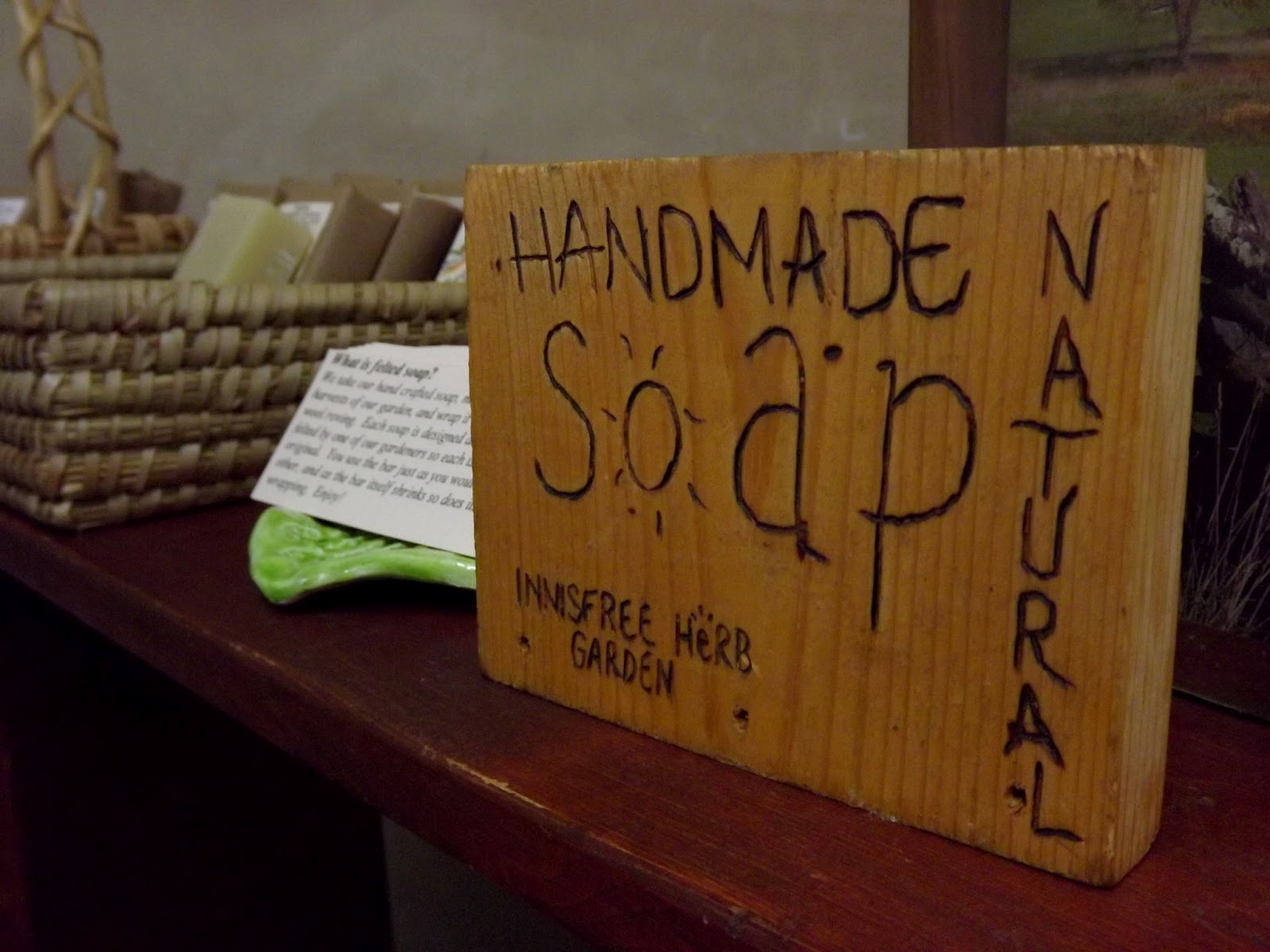
Herbal Soaps wrapped in felted Lambs Wool.
We were greeted by Nancy who took us on a tour of the village and introduced us to some of the residents who were busy weaving beautiful blankets, placemats, and scarves or preparing to plant 1,000 Sweet Potato starts.  It's not all work and no play, there is a really nice pool and many residents were preparing to jump in to cool off.

A cooks dream, Bloggett Ovens.

We visited the Bakery where Granola and Bread is baked.  It's complete with two massive commercial pizza ovens.  We also toured the wood shop where beautiful handmade wooden utensils and cutting boards were being assembled.


I'm always drawn to farm animals and herbs so I enjoyed seeing the free roaming Lambs and Chicken Coops complete with lots of Chickens.

Eggs and Granola can be purchased at Rebecca's Natural Food in Charlottesville.  We toured the Herb House were soaps are made and cut flowers are bundled to resell at the local Grocery, and the smell was divine.  Residents grow crops and flowers to enjoy and also to sell (some items can be purchased online).  Innisfree is quite a busy place.

Beautiful Peonies ready for the market.
The organizational purpose at Innisfree is "...to acknowledge the reciprocal relationship between human and health and the natural environment."  I guess that's why I'm so impressed with Innisfree, the environment is respected as are the human beings.

-Rebecca


Monday, September 17, 2012

Monticello Heritage Harvest Festival a Winner

Thomas Jefferson's Garden
Saturday I wallowed in Gardener Heaven at the Heritage Harvest Festival at Monticello in Charlottesville, Virginia. This festival is a must, must, must, must attend if you are a gardening junkie like me.  There is exhibit after exhibit related to gardening, homesteading, farming, nature, plants, natural eating, and DIY. 

This year I made it out of my house at 8:15 am to get first dibs at the Old Timey Seed Swap.  It's amazing to see the generosity of gardeners.  There was a vast assortment of containers full of copious amounts of SEED fresh from the gardener.  Some seed swappers had made the trek from other states!  This is a big event for those that especially grow vegetables.  It seemed a little less crowded this year so I had plenty of time to look through all the colorful offerings.
 
After about an hour of this I began roaming the festival, searching out food samples and checking out the few chickens and Jersey cows that were in attendance this year.  I'm not a big fan of bringing animals to festivals but all were in the shade and well cared for.  It provides a chance for city kids to see farm animals and shockingly, some have never petted a farm animal!

The festival seems to grow each year, and I discovered several interesting booths.  The Xerces Society had a lot of timely information about our vanishing bees.  Typically we think of raising bees in handmade hives but this group is focused on native species and the lack thereof.  They currently are in search of 2 native bee species and sightings should be reported.


In the midst of booth hopping I came across the top freebie at the festival - hot liquid CHOCOLATE.  I am ashamed to say that I snuck back six more times to get a shot glass of liquid lava.  At first I tried to disguise myself... putting on a hat, taking off a hat, putting on glasses, taking off glasses... in the end deciding to just duck down and stick my arm through the hordes of people that had also caught onto this delicious delight.  I dreamed about it that night, bathing in hot liquid chocolate.

During the day a large array of seminars are held.  There were so many things to taste, booths to see, plants to view, and music to hear, I barely made it to two seminars.  I found the "You CAN bake bread" seminar interesting hosted by Deborah Niemann.  One recipe of yeast, flour, water, and salt - does it all.   I also enjoyed the well attended Chicken Whispering discussion by expert Patricia Foreman.   I loved the part of her discussion about involving your chicken in dinner parties and TV viewing... chickens are more "pet like" than most people realize.

Lastly, I sat at the local chicken groups booth for an hour, CLUCK.  Talking to chicken owners and those planning on having a flock one day.  The numbers are certainly growing and I always advise those interested in getting a flock to look for chickens in need.  As the popularity for a certain pet expands, so does the discarding of those pets (Dalmatian explosion from the re-release of the movie 101 Dalmatians is just one example).  My six hens are "rescue" hens and I would not do it any other way.

Yellow Hibiscus with Monticello in the background.
It was a glorious day, one spent relaxing, observing, and learning up on the top of the world among fellow gardeners... sucking down chocolate... BLISS.

-Rebecca


Related Posts Plugin for WordPress, Blogger...