Showing posts with label Charlottesville Albermarle SPCA. Show all posts

Thursday, June 30, 2011

Cat Behavior Expert

Cat
A few minutes before the seminar began.
Early this week, area cat lovers attended a sold out seminar hosted by the Charlottesville Albemarle SPCAJoan Miller, Vice President of the Cat Fanciers Association, came to the UVA Caplin Auditorium to share her cat behavior expertise.  Joan has 30+ years of experience in handling cats to determine and often adjust their behavior to make them adoptable.

Joan had been at the SPCA for several days accessing cats and training staff.  For her presentation, she selected a group of ten hissy shelter cats to illustrate proper handling and care to get positive behavior from a cat.  Animal control facilities often only keep cats for 72 hours, and Joan's years of experience has verified that that is often too short of a holding period.  It can take weeks of slowly and gradually adding challenges to the cat before it comes around allowing human interaction.

Joan illustrating scent glands.
One of the cats that she brought to the seminar was residing in the SPCA "barn cat" room at the shelter.  Found free roaming and thought to probably be semi-feral, she had the cat out in front of a packed room that was as comfortable and friendly as any other cat she handled.  Obviously, the cat had been acting unsocial at the shelter but with her careful handling she brought it out of its shell and it can now be adopted into a home!

Joan's CARE CARE and FACTS:
  • The number one thing cats want is PLEASURE FOR THEMSELVES! 
  • A Safe, clean, and comfortable environment.
  • Cats are cautious observers.
  • Gradual change and predictability.
  • Some adversity and challenge each day.
  • Cats are much more smell, than visually oriented.
  • There are 400+ colors and patters in Pedigreed cats.
  • All cats are black and tabby (genes will mask the tabby marking making it a solid or the black color making it yellow for example).  Genes can also affect the eye coloring.
  • A cat is not called a Calico (orange, white, black) UNLESS the black is solid colored.  It is a tabby mix.
  • Often blue eyed white cats are deaf, often if one eye is green, that side will be hearing but the blue side will be deaf!
  • If your cat has copper eyes then you can almost be certain it has pedigree in its background. 
SPCA kitten calmly sitting in room full of cat lovers.
Another interesting fact from Joan was that when you raise a 4 - 8 week old kitten you should NEVER put anything in the cage or area that will allow the kitten to scratch (for the exception of the litter box).  It has been studied and proven that this will prevent them from developing that bad behavior of scratching your furniture and other valuable items.  Proper kitten behavior is learned during this time period and it is so important for a kitten to learn from its mother or another kitten "proper behavior".  It's best to raise a kitten w/another friendly cat.

My obviously relaxed cat Gus.
Joan is was amazing and I know that each person in the room learned something new about our special felines during the presentation.

-Rebecca

Wednesday, December 1, 2010

Help Feral Cats

I'm feeling no pain waking up from surgery
One Saturday a month during the cool seasons of the year, Voices for Animals coordinates the Feral Cat Clinic held at the Charlottesville Albemarle SPCA to spay and neuter approximately 100 cats in 8 hours.  Ferals are cats that can not be handled by humans and require trapping in order to be safely caught.

--- A female cat continuously cycles in and out of heat and can get pregnant while nursing a litter so spaying is the humane way to control feral cat populations.  Otherwise you can guarantee continual births of babies in the wild time after time after time. ---

Your ears are fifie dirty!
This is my second year of volunteering for the Feral Cat program.  The clinics have been run for so many years that it is a very structured and organized effort.  Some volunteers have participated season after season and are pros.  Most volunteers work "hands on" at various surgery "stations" such as prep, pre-surgery, fluids, medications, and recovery. 

Other volunteers provide support by trapping and returning the cats back to where they originated or bringing in food for the volunteers.  Mass quantities of delicious vegan dishes magically appear each morning and continue through lunch.  Seventy volunteers have to be fed throughout the 8 hour (+/-) surgery day.  Approximately five vets perform the surgeries along with licensed techs and other trained staff.

The program addresses a community need by controlling cat populations in order to help these animals which may otherwise never receive vet care.  If an injury is discovered the cat is treated or patched up.  All cats are vaccinated for rabies and distemper and are humanely sterilized, undergoing the same surgery protocol found in any veterinarian hospital.

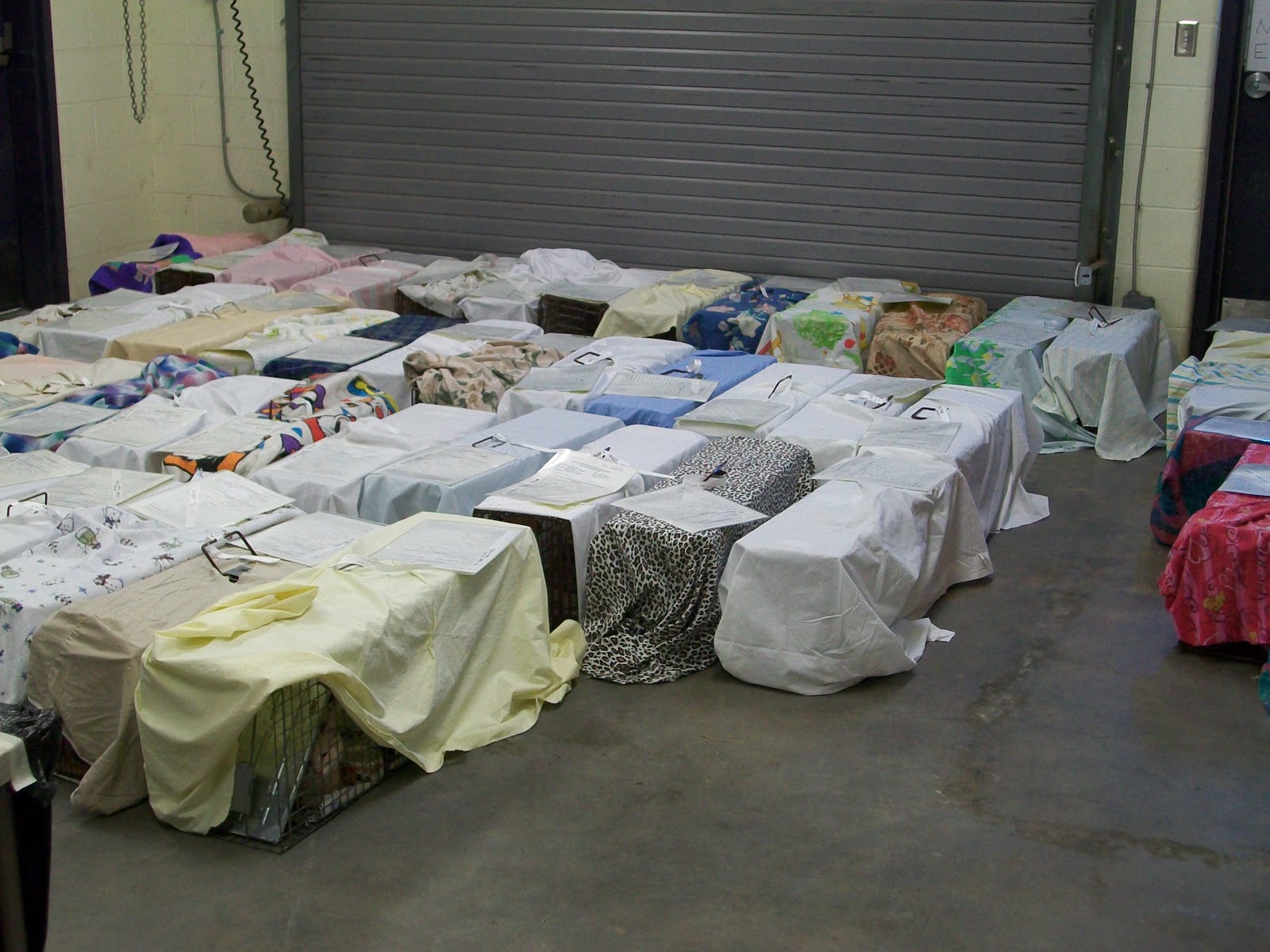
Just a few trapped cats - cages are covered to reduce stress
You may be asking, why not just permanently remove the cats?  This has been studied and once you remove the cats, more cats come into the community and set up camp, restarting the cycle once again.  Working in a shelter, I can promise you that euthanizing feral cats does nothing to control the population.  The same people would bring in cats year after year, never relieving themselves of cats!  The proven solution is to stay on top of the situation and get them fixed and release them back where you found them.

If you know of a cat that is roaming in the Charlottesville area and may need to be fixed OR if you can help volunteer, please contact Voices for Animals.  They are eager to help guide you through the process and help a feral in need!  

-Rebecca

For Southwest Virginia Readers, Spay Clinics in your area:  Pulaski County, Montgomery County
Related Posts Plugin for WordPress, Blogger...